It’s time to talk about the Fitzpatrick scale. If that sounds like something from a high school biology textbook, don't worry, we're keeping the clinical jargon to a minimum.
If you're currently transitioning away from waxing or shaving, one of the biggest mental shifts you have to make is understanding that your specific skin tone suddenly matters a great deal.
When you use a razor in the shower or pull a wax strip off your bikini line, your skin tone is entirely irrelevant. Unlike shaving or waxing, IPL (Intense Pulsed Light) relies entirely on the intricate physics of light absorption rather than physical pulling or cutting. Because of that fundamental difference, knowing your exact skin tone isn't just a secondary beauty metric. It's the absolute foundational rule of safety and success.
Let's break down the science behind why your settings matter so much, and look at the most reliable ways to find your perfect match.
The melanin competition
To grasp the connection between your skin tone and your hair removal results, you need to know what the device is actually doing.
When a clinical-grade IPL device flashes, it sends a powerful spectrum of light energy down into the skin actively searching for one specific target: melanin. This natural pigment gives our skin and hair its unique color, and it absorbs light energy incredibly well.
Think about wearing a black t-shirt on a bright July afternoon. You already know the black fabric absorbs sunlight and gets hot very quickly. If you wear a white t-shirt on that same afternoon, the light reflects off the fabric, keeping you much cooler.
When the light energy from the device finds the dark melanin inside your hair root, the pigment absorbs that light and converts it into a targeted burst of thermal heat. That heat gently shuts down the active hair follicle.
The physics gets tricky because the light can't actually tell the difference between the melanin in your hair root and the melanin in your skin. It just sees pigment and heads straight for it.
If you have very light skin and very dark hair, you have high contrast. The light passes harmlessly through the light skin and dives straight down to the dense melanin in the dark hair root. However, if your skin has more melanin, the surface begins to actively compete with the hair root for the light's attention. Using an IPL device on a deeper skin tone means the melanin in the skin will absorb that light energy before it ever reaches the hair root. The hair follicle doesn't get treated, and the surface of your skin gets uncomfortably hot. This exact physics problem is the reason proper settings are mandatory.
Determining your skin tone
So, how do you figure out exactly how much melanin you're working with?
This brings us to the Fitzpatrick scale. Developed by a Harvard dermatologist in the 1970s, this scale classifies human skin into six distinct types (Type I through Type VI) based on two factors: how much melanin is present, and how your skin reacts to ultraviolet light.

When you unbox a Sensica IPL device, you'll find a printed color-matching chart included in the materials to help you visualize these categories. The instructions ask you to match your skin to one of these colored shapes to determine your safe treatment level. While this sounds easy in theory, color matching is surprisingly difficult in practice.
First of all, bathroom lighting is notoriously terrible. We all know the struggle of applying foundation in the bathroom, only to step outside and realize our face is a completely different color than our neck. You don't want to apply that same margin of error to a thermal light device.
Secondly, your skin tone is almost never uniform across your entire body. Your outer legs might be beautifully tanned from a recent beach vacation, putting them at a solid Level 4 on the scale. Meanwhile, your inner thighs might be several shades lighter at a Level 2, and your underarms might have slight hyperpigmentation.
To use the printed chart correctly, you need to follow a few strict guidelines. Always evaluate your skin tone in natural daylight rather than under the warm yellow bulbs of your bathroom vanity. Most importantly, you must check the exact area of the body you're about to treat. You can't match the chart to your forearm and then apply those settings to your bikini line.
While looking at a printed color chart is helpful, the most accurate way to determine your Fitzpatrick type is actually by looking at your sun exposure history. The scale asks a very specific question: what happens to your skin when you spend time in the sun without protection?
If you always burn and never tan, you're likely a Type I. If you burn easily but can eventually develop a slight tan, you fall into Type II. Type III burns moderately but tans gradually, while Type IV rarely burns and tans easily to a moderate brown. Type V very rarely burns and tans profusely, and Type VI never burns, representing the deepest levels of melanin pigmentation.
The adaptive sensor: your built-in assistant

Even with perfect natural lighting and a solid understanding of your sun exposure history, human error is always a possibility. We designed our devices to account for that.
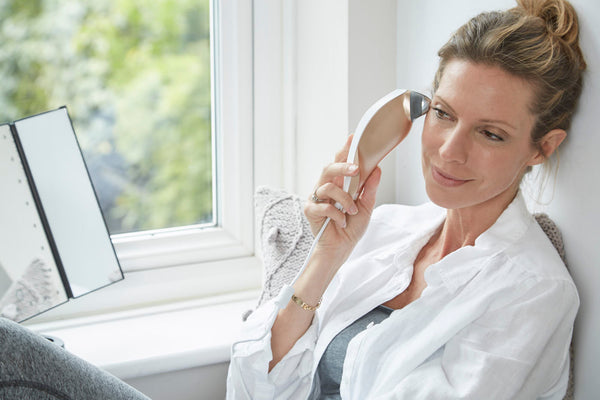
Clinical-grade devices like the Sensilight Pro feature advanced adaptive skin tone sensors built directly into the treatment window. These sensors aren't there to take control away from you. They're there to act as a highly trained assistant.
When you place the Sensilight Pro against your skin, the sensor takes a split-second reading of your exact melanin levels in that specific patch of skin. It evaluates the contrast and does the math for you. Instead of hijacking the settings, the sensor just suggests the maximum safe level for that area 1 . It gives you the data, but you stay entirely in control. If the sensor suggests Level 4, but you prefer the gentle warmth of Level 3, you make the call.
The sensor does have one hard rule. If you accidentally place the device over a dark mole, a dense freckle, or a patch of skin that's simply too dark to be safely treated (like a Fitzpatrick Type VI), the sensor immediately detects the dense concentration of melanin. It acts as a hard stop and physically locks the device from flashing. You can press the trigger as many times as you want, but the device will politely refuse to hurt you.
The ultimate safety lock: tight skin contact
Speaking of safety locks, let's address the single most common fear people have when unboxing an IPL device for the very first time.
Because IPL uses incredibly bright flashes of intense light, people are understandably terrified of accidentally flashing themselves (or a pet wandering into the bathroom) in the eye. It's a very valid concern. Though our devices are absolutely not a risk to your eye-sight, staring directly into a high-powered flash lamp might make for some very unpleasant moments.
This is exactly why premium at-home devices are engineered with a secondary, fail-proof safety mechanism: the skin contact sensor.
The Sensilight Pro (or Sensilight Mini, come to that) physically can't flash open air. It doesn't matter how hard you pull the trigger or what energy setting you've selected. Unless the treatment window is making full, tight, flush contact with your skin, the flash mechanism is completely disabled.
- Available in the EU and UK markets only.